Skip to content
AFSAH

NAME0x0 · Dubai

Muhammad Afsah Mumtaz

Systems & ML engineer. I build systems under real constraints.

Ideas tend to arrive together. I get caught up in finding the connections, following them across fields, and seeing what I can bring into the same project.

Now AVA v3, a coding specialist, in research

Contact Open to systems and ML work · Dubai or remote

Email me

Same particles. Different states.

Work

Things I build

Windows desktops and shells, native tools, a language, web experiments, trading agents and small models.

Full portfolio CV

All 18 projects

Every repository on GitHub

In depth AVA · How much can a small model learn?

Train a small model from scratch.

Models of 11M to 99M parameters, trained on a laptop GPU with 4 GB of VRAM. The bare 14M baseline scored about 24% on ARC-Challenge. Guessing scores 25%.

Add parts. The ceiling holds.

Retrieval, memory and tool scaffolds joined the model. A retrieval ensemble reached 91 of 299. The limit was knowledge: a model this small cannot store enough of it.

Start from a model that already knows.

Qwen3.5-2B does not fit the card at 16-bit. Loaded in 4-bit NF4, it does. Its weights stay frozen; only a thin QLoRA adapter trains.

The run worked. The score did not move.

AVA v1 trained on 5K examples for one epoch: 66% on ARC-Challenge, exactly the base model. A completed run was not an improvement.

Change the material, not the machine.

A 20K curated corpus of maths, science, reasoning and tool examples. Peak training VRAM: 1.81 GB. ARC-Challenge: 82.0% on all 1,172 questions.

Ship the adapter. Keep the trail.

AVA v2 ships as a 42 MB adapter with quantized GGUF builds. The Gemma 4 branch is paused; v3 is in research. Maths, narrative commonsense and tool use remain weaker.

Repository-reported. Caveats

AVA v2 · 42 MB adapter
The AVA record, as text
Exp 1–3 · doneScratch baseline14M params24% ARC ceiling
Exp 4 · releasedQwen 3.5 QLoRAAVA v1 → AVA v282% ARC ceiling
Exp 5 · pausedGemma 4 inference26B / E4B / E2B~6.4 tok/s peak
Exp 6 · activeAVA v3 ternary MoE+ MCP toolsscaffolding (P0)
From AVA / docs / EXPERIMENTS.md

How much can a small model learn?

AVA began with small models trained from scratch. Tokenisers, retrieval and memory all became part of the experiment. The models reached a knowledge ceiling; the useful parts stayed.

Keep the question. Reconsider the starting point.

Build on what already knows.

The next approach adapted a pretrained model with QLoRA. It made training on the laptop practical, but the first fine-tuning attempt did not improve ARC reasoning over the base model.

A working training run was only the beginning.

The data became the work.

A larger, curated mixture of science, maths, reasoning and tool examples followed. Training optimisations and a broader evaluation pipeline grew alongside it.

Improve the material. Check the result.

Release a result. Keep the question.

AVA v2 became a downloadable adapter and local model. The experiment history keeps the failed and paused branches too: a record of what was tried, what shipped, and what is still open.

A release is a place to continue from.

Person

Outside the work

Ideas tend to arrive together. I get caught up in finding the connections, following them across fields, and seeing what I can bring into the same project.

Some moments from outside the repositories.

The photo collection About

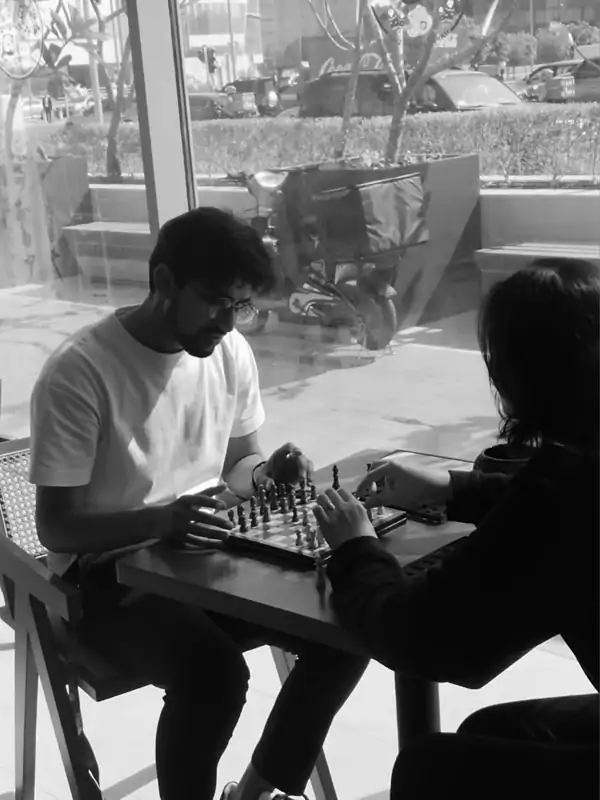
Afsah playing chess at a table by a window.
A game by the window.
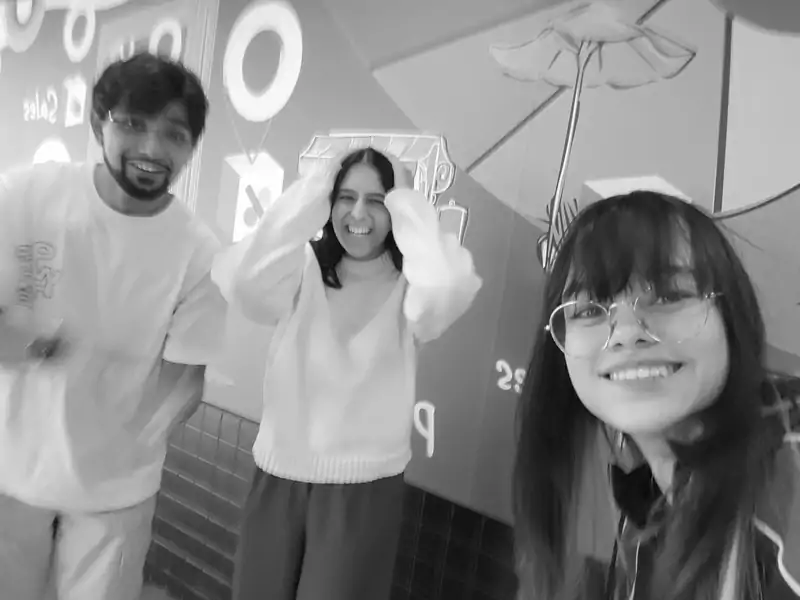
Afsah with two friends in front of a painted mural.
Good company.
Portrait of Afsah in round glasses, a hand at the chin.
Thinking it over.

Questions

What keeps pulling me in

Separate repositories, recurring questions. The body takes each project's shape in turn; hover a question to choose one. These projects do not depend on one another, but they keep returning to limits, choices and coordination.

  1. How much can a small model learn?AVA · v2 released · v3 in researchA local AI project shaped by a laptop GPU: from scratch models to a released adapter, with the experiment history kept alongside the result.
  2. What should happen next?Jevlet · Research implementationA small model that chooses among available actions, joined to a Windows assistant that shows its interpretation and asks when confidence is insufficient.
  3. Where should the thinking happen?OMNI · Partial implementationAn exploration of sparse experts, geometric routing and streamed execution under consumer hardware constraints. The architecture is ambitious; its unproven parts are explicit.
  4. How does intelligence work together?OpenEchelon · Pre-alpha · models + governor spikeAn organisation model for AI work: persistent identities, explicit responsibility and governed resource choices. The first prototype tests the premise before the full runtime.

Explore

Walk the rooms

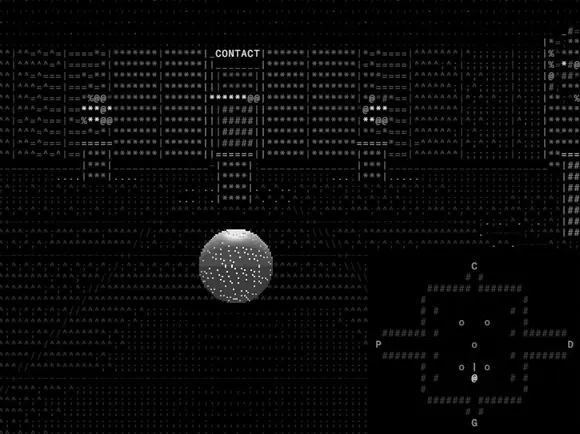
Six rooms drawn in characters, with a rolling point cloud at the centre. Follow the gates, read the exhibits, collect the torn fragments. Exit at any time; the world starts fresh each visit.

Arrow keys or W A S D · touch controls · map · Escape to leave

The first room of the world, drawn in ASCII characters, with the point-cloud sphere at its centre and a map of the room.
Origin room, as drawn.

SAME PARTICLES / DIFFERENT STATES

Inside the world